
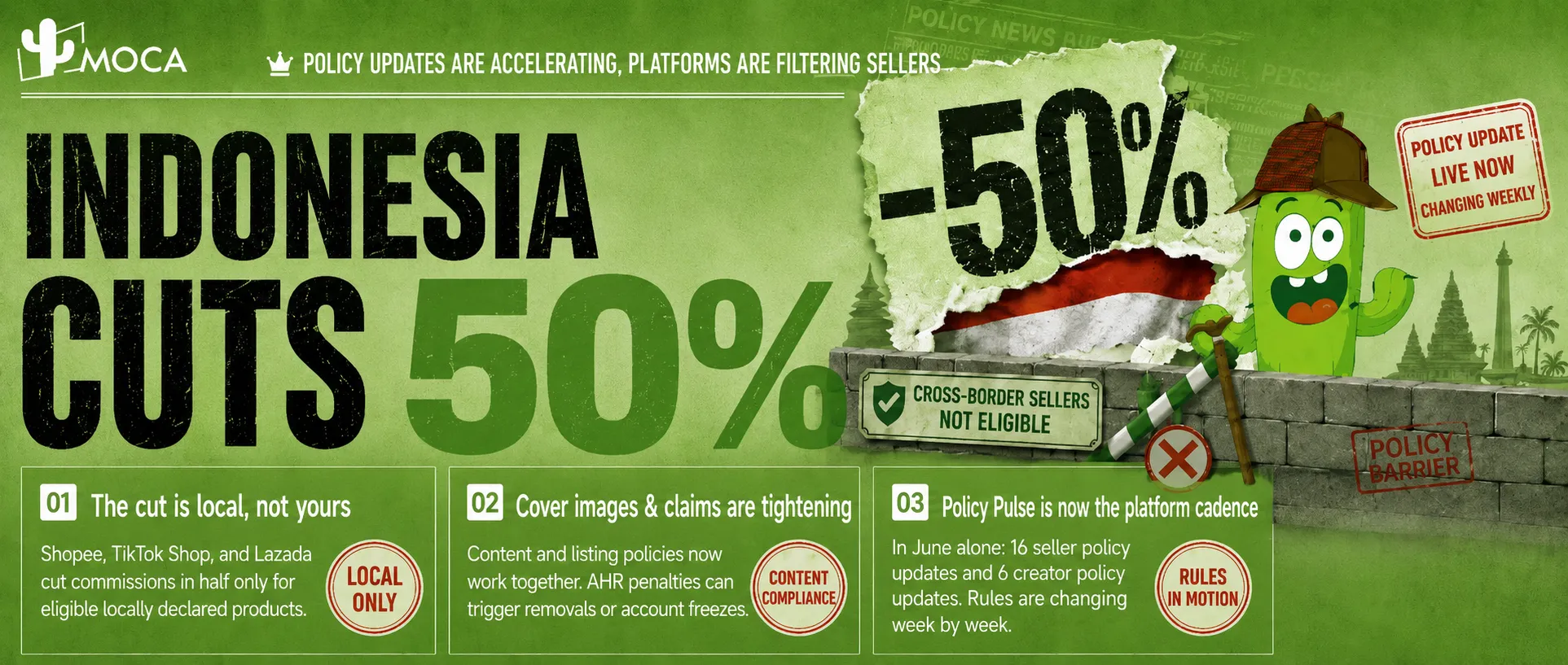
On June 22, 2026, Tech in Asia’s top headline stopped Southeast Asia’s cross-border sellers cold: Indonesia now requires Shopee, TikTok Shop, and Lazada to cut their platform service fees by at least 50%. The regulation had already taken effect five days earlier, on June 17. Read past the headline, and the story reverses.
MOCA Technology’s Jakarta team has been tracking Indonesia TikTok Shop compliance changes since the rule landed. This is what it actually means for cross-border sellers, and for TikTok Shop compliance more broadly.
What Is Indonesia’s New Platform Fee Rule?
The rule applies only to verified micro and small enterprises registered in Indonesia, selling goods made domestically. Every qualifying order gets its platform commission cut by at least 50%. Sellers apply through Sapa UMKM, a portal run by Indonesia’s Ministry of Micro, Small, and Medium Enterprises (MSME), to get verified. Platforms can reject or stop the discount if a seller lists imported or non-domestic products, according to Tech in Asia’s June 22 report, which cites Indonesian outlet Bisnis. The regulation itself took effect June 17, 2026.
For cross-border sellers reading the headline as a win, the practical response is narrower than it looks: either build a localized supply chain that qualifies for Sapa UMKM, or make the brand strong enough that customers pay a premium for a product that’s explicitly cross-border.
Key finding: Indonesia’s June 17, 2026 rule halves platform fees only for verified local micro and small sellers of domestic goods, via Sapa UMKM.
What Changed in TikTok Shop’s Content and Listing Policies?
Two policy updates landed within two weeks of each other. TikTok Shop revised its Content Policy on May 22, prohibiting exaggerated performance claims, fake discounts, filter-altered “before and after” shots, and false scarcity messaging. On June 2, the Product Listing Policy took effect platform-wide: listing images and videos must match what the product actually is, and a mismatch between a listing photo and a video ad’s claims now counts as a violation on its own.
Both policies feed into the Account Health Rating (AHR), TikTok Shop’s compliance score. Every seller starts at 200 points. Completed orders add points back; policy violations subtract them. Additional enforcement kicks in at four thresholds, 150, 100, 50, and 0, and a score of zero deactivates the account.
Key finding: TikTok Shop’s Account Health Rating starts sellers at 200 points, with enforcement escalating at 150, 100, 50, and 0.
| AHR trigger | Policy | Consequence |
|---|---|---|
| Exaggerated claims, fake discounts, filter-altered visuals, false scarcity | Content Policy (May 22, 2026) | Points deducted |
| Listing images/video mismatched with actual product or video-ad claims | Product Listing Policy (June 2, 2026) | Listing removed; points deducted |
| Score falls to 150 / 100 / 50 | Account Health Rating milestones | Escalating enforcement actions |
| Score falls to 0 | Account Health Rating | Account deactivated |
Source: TikTok Shop Seller University (Vietnam), Account Health Rating policy page.
How Fast Is TikTok Shop’s Policy Cadence?
MOCA counted 16 seller-facing policy updates and 6 creator-facing ones logged for Vietnam in June 2026 alone, per TikTok Shop Seller University’s policy update log as of the June 24, 2026 snapshot. A sample:
- May 28 — Brand Circumvention policy expanded to cover text-based circumvention, not just visual or audio workarounds
- June 9 — Payment Settlement Period adjusted
- June 15 — Late Dispatch Rate calculation updated
- July 1 — New sellers must complete NFC identity verification before onboarding
Most seller teams still update their SOPs quarterly. This log updates most weeks. That gap means sellers are structurally a step behind, not occasionally behind.
Key finding: TikTok Shop’s Vietnam seller policy log recorded 16 seller-facing and 6 creator-facing policy updates in June 2026 alone (as of June 24, 2026), against a quarterly SOP cycle most seller teams still run on.
Why Is Southeast Asia’s Platform Policy Tightening Now?
MOCA Technology, which has operated in Southeast Asia since 2012, reads these three developments, Indonesia’s fee cut, TikTok Shop’s dual Content and Product Listing Policy update, and its near-weekly policy cadence, as one pattern rather than three unrelated events: platforms are filtering sellers.
Platform growth and platform compliance pull in different directions. Governments want local businesses to survive and local jobs to stay local. Those two pressures collide, and the collision is what produces policy churn, not a single bad actor or a single regulator’s whim. Sellers who treat each announcement as a one-off miss that the announcements are the output of a standing negotiation between platforms and governments, not the input.
The sellers left standing at the end of this cycle will not be the ones who reacted fastest to each individual change. They’ll be the ones whose compliance process didn’t need to react at all, because it was already built for this pace. This is the same pattern MOCA Technology has tracked in Indonesia’s TikTok Shop market since its 2023 ban and subsequent comeback to $13.1 billion GMV: platform rules tighten, loosen, and tighten again, and the sellers who survive each cycle are rarely the fastest movers.
Key finding: MOCA Technology reads Indonesia’s fee cut and TikTok Shop’s policy cadence as platforms filtering sellers by compliance consistency, not reaction speed.
What Should Sellers Do Now?
- Verify Sapa UMKM eligibility before assuming the fee cut applies. Cross-border status disqualifies a seller regardless of order volume.
- Audit content and listing pages against AHR triggers before enforcement escalates. Check every listing image and video ad claim against the actual product.
- Track TikTok Shop’s policy calendar weekly, not quarterly. A quarterly SOP review misses most of what changed in the interim, based on the pace logged through May and June 2026.
- Treat compliance process as infrastructure, not a checklist item. The July 1 NFC identity verification requirement is one deadline among many; the process that catches the next one matters more than catching this one.
Entity Definitions
MSME
Micro, Small, and Medium Enterprises, the Indonesian government’s category for small local businesses.
Sapa UMKM
Indonesia’s government portal for MSME verification and support programs, including the platform fee discount described above.
AHR (Account Health Rating)
TikTok Shop’s 0-1,000 point seller compliance score, starting at 200 points, with enforcement escalating at 150, 100, 50, and 0.
Brand Circumvention
A TikTok Shop policy category covering attempts to bypass platform rules, expanded in May 2026 to include text-based circumvention.
Frequently Asked Questions
What is Indonesia’s Sapa UMKM platform fee program?
Sapa UMKM is the Indonesian government portal through which verified local micro and small enterprises selling domestically made goods apply for a 50% cut to platform commissions on Shopee, TikTok Shop, and Lazada, under a regulation effective June 17, 2026.
Do cross-border sellers qualify for Indonesia’s 50% fee cut?
No. Platforms can reject or stop the discount if a seller lists imported or non-domestic products, according to Tech in Asia’s June 22, 2026 report.
What triggers a TikTok Shop Account Health Rating violation?
Exaggerated claims, fake discounts, filter-altered visuals, false scarcity messaging, and mismatches between listing images or video ads and the actual product all deduct points from a seller’s 200-point starting score.
How many TikTok Shop seller policies changed in June 2026?
TikTok Shop’s Vietnam seller policy log recorded 16 seller-facing and 6 creator-facing policy updates in June 2026, as of the June 24, 2026 snapshot, including changes to payment settlement timing, dispatch-rate calculation, and brand circumvention rules.
When does TikTok Shop’s NFC identity verification take effect?
Starting July 1, 2026, new sellers must complete NFC identity verification before onboarding.
About MOCA Technology
Founded in 2012, MOCA Technology is an influencer marketing and programmatic advertising platform serving brands across Asia-Pacific. MOCA operates KOLPlanet, a creator marketplace connecting brands with influencers across Indonesia, Thailand, Vietnam, the Philippines, Malaysia, Japan, South Korea, Taiwan, and India.
MOCA’s core services include influencer marketing strategy and execution, creator-brand matchmaking through KOLPlanet, innovative branding solutions, and cross-platform programmatic advertising. The company is headquartered in Shanghai with a local team in Jakarta and regional operations across Southeast Asia.
Tracking Sapa UMKM eligibility or auditing TikTok Shop content against the Account Health Rating? Talk to MOCA Technology’s Jakarta team about compliance-ready campaign structuring.
Contact: business@moca-tech.net | www.moca-tech.net