
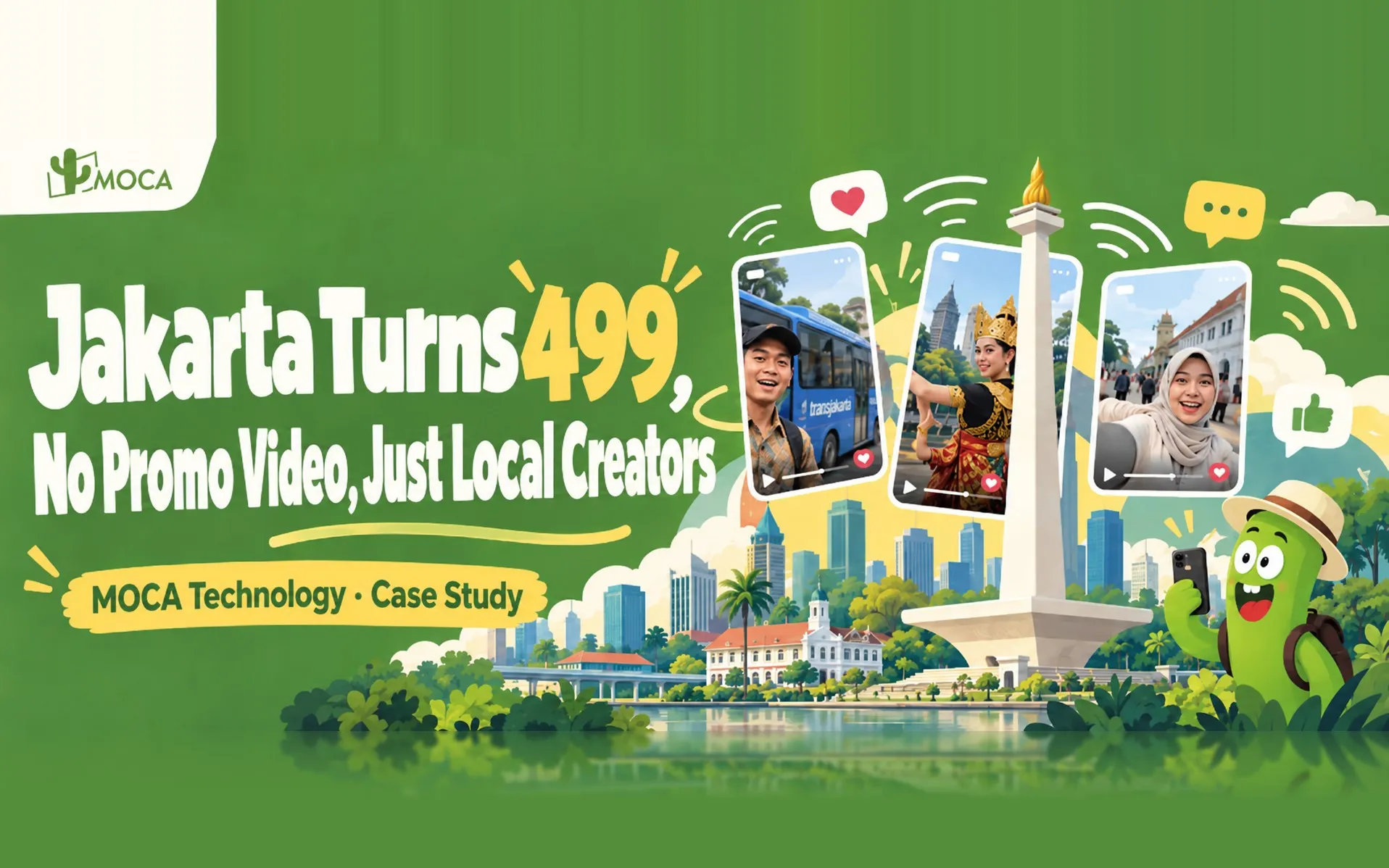
A creator-led city campaign uses local creators instead of an official film to explain a city’s perks, places and culture. MOCA Technology ran one for the Jakarta Tourism Office in 2026. The occasion was Jakarta’s 499th anniversary. The campaign had three tracks (residents’ hopes, transit tests and cultural exploration) built on the city’s perks: Rp1 transit fares and free museum days. Local creators and one campaign account, Spill Jakarta, turned those perks into steps residents could follow the same day.
Case study video, 34 seconds, with Chinese and English captions: how MOCA turned Jakarta’s 499th anniversary into a creator-led campaign.
What problem did Jakarta’s 499th anniversary campaign have to solve?
Jakarta turned 499 on June 22, 2026 (Marclan International), one year before its 500th. The city counts its founding, under the name Jayakarta, from June 22, 1527 (Wikipedia). The provincial government marked the year with perks residents could use:
| Perk | What it was | Dates (2026) |
|---|---|---|
| Transit | Flat Rp1 fare on Transjakarta, MRT Jakarta and LRT Jakarta | June 22, 27, 28 |
| Free entry | City museums, including the Jakarta History Museum and the Betawi Museum; Ragunan Zoo; Monas | June 22, 27, 28 |
| Free entry with conditions | Ancol Dreamland main gate, for Indonesian ID holders with an online reservation | June 22, 27, 28 |
Source: detikNews (fares, from the Jakarta transport agency’s notice), detikEdu (venues and conditions) and the campaign account’s June 17 post.
The celebration peaked at Bundaran HI on June 27 and 28 under the title “Menuju 5 Abad Jakarta” (Toward Five Centuries of Jakarta). The Rp1 fares on those two days were open to all riders with no Jakarta ID requirement, according to the provincial government’s release.
The brief, as MOCA’s case video frames it, was to turn a major city milestone into an authentic, widespread civic movement in Indonesia. An official notice reaches people who already follow official channels. When it does not reach everyone else, the perks go unused and the city gets little public credit for the spend.
Key finding: Jakarta’s anniversary perks, Rp1 fares and free venues on three set dates, were concrete and time-limited. The campaign’s job was to make sure residents knew how to use them in time, and to make that information easy to pass on.
How did MOCA turn the perks into a creator-led campaign?
MOCA Technology skipped the standard official promotional film. Local creators told the story in their own voices, and one account, Spill Jakarta (@spill.jakarta), collected the practical information. The work ran in three tracks between June 14 and late August 2026:
| Track | Dates (2026) | What went out | Public record |
|---|---|---|---|
| Resident hopes | June 14, June 22 | Prompts asking residents for one wish for Jakarta (cleaner air, less traffic or a raise) and their vision for Jakarta at 500 | June 14, June 22 |
| Transit tests and guides | June 17 to 23 | The perk list and dates (June 17), a Jakarta Fair transit guide with four dedicated TransJakarta routes (June 19), creator reels on riding the Rp1 services (June 22 and 23) | June 17, June 19 |
| Cultural exploration | July 7 to August 28 | Betawi traditional dress explained (July 7), a creator’s visit to the Betawi Museum in Setu Babakan (July 14), legendary local eateries (August 28) | July 7, August 28 |
Source: Spill Jakarta’s public Instagram posts, linked in the last column. Creator reels are public and are not linked here.
Two details connect the tracks. Creators pointed to the account as their source: the reels from June 22, June 23 and July 14 each credit @spill.jakarta for routes or updates. The case video’s closing frames also describe the aim as making the account “Jakarta’s cultural voice.” According to MOCA Technology’s project record, the Jakarta Tourism Office responded with strong approval.
Key finding: MOCA Technology ran Jakarta’s anniversary story through three creator tracks and one information account. The public record shows dated prompts, transit guides and culture posts, and creators who credited the account as their source.
What can a resident’s video do that an official notice does not?
Officials announced Jakarta’s Rp1 fares and museum entry, and creator videos then explained how to use them. Three things set the videos apart.
Officials list what exists. Residents show how to get there. The perk list gave dates and venues. The Jakarta Fair guide went further and named four dedicated TransJakarta routes (2C, PRJ 1, PRJ 2 and PRJ 3) and the nearest KRL stations. The case video’s transit shots are filmed from the rider’s side, inside an MRT carriage and on a TransJakarta trip captioned “Naik TJ ke Museum Betawi” (take TransJakarta to the Betawi Museum). A viewer could leave the house the next day.
The perks ran on three dates. The dates list went out on June 17, the Jakarta Fair guide on June 19 and the creator reels on June 22 and 23, ahead of the June 27 and 28 weekend. A guide that arrives after the date is a recap.
The audience is large and layered. Indonesia had 180 million social media user identities in October 2025, equal to 62.9% of the population, according to DataReportal’s Digital 2026 report. A single official channel does not reach all of them. Creators at different tiers reach different segments of that audience, which is why this campaign matched creators to segments instead of relying on one large account. Our earlier piece on micro and nano influencers in Southeast Asia covers the same logic.
Key finding: An official notice says what a perk is, and a creator video shows how to use it. With perks on only three dates and an audience spread across many segments, the practical levers were timing and creator fit.
Are Chinese cities using the same playbook?
Two 2026 cases from China follow the same logic: residents or netizens start the story, and the city amplifies it.
Hechuan, Chongqing. A viral online call to help hold down a pig for a New Year pig feast drew hundreds of thousands of online viewers, and the district received more than 3.6 million visitors over the Spring Festival holiday, according to Xinhua. The district then built folk-custom activities around the moment instead of treating it as a one-off.
Mingguang, Anhui. Online users misread a local liquor brand’s hand-lettered name as “Nai Lu Bo” (milk green wave), and the joke spread. The city government launched a milk tea and a mung bean cake under the joke names. Scenic spots received nearly 120,000 visitors over the spring break and the Qingming holiday, with tourism revenue above RMB 120 million, according to China Youth Daily via Sina Finance.
Key finding: In both Chinese cases, residents or netizens started the story and the city amplified it with usable offers and activities. Jakarta’s campaign used the same division of labor: creators spoke, and the city supplied the perks.
What can brands reuse from a city campaign?
A city moment such as an anniversary, a traditional festival or a large expo can be run the way Jakarta’s was. The sequence:
- List the usable perks and their exact dates. In Jakarta: Rp1 fares and free venues on June 22, 27 and 28.
- Give each creator track one audience action. In Jakarta: share a hope, plan a trip, visit a place.
- Match creators to audience segments. In Jakarta: transit, culture and food content used different creators and formats.
- Publish practical content ahead of the dates people will act on. In Jakarta: the perk list on June 17, the Jakarta Fair guide on June 19 and creator reels on June 22 and 23, before the June 27 and 28 weekend.
- Give creators one information source to credit. In Jakarta: creator reels pointed to @spill.jakarta for routes and updates.
- Tie the moment to a place or tradition locals share. In Jakarta: Betawi traditional dress and a museum visit.
Skip this approach when there is no concrete perk or information for residents to use.
For a worked example of tying content to a local calendar moment, see our guide to Ramadan marketing in Indonesia.
Key finding: A city moment gives a brand six jobs: list the perks, assign one action per track, match creators to segments, publish early, name one source and tie the story to a shared place. Each job in Jakarta’s campaign has a dated public record.
What does it take to run this playbook in Southeast Asia?
Three requirements decide whether the approach works.
Local cultural literacy. A Rp1 fare, the meaning of Betawi traditional dress and a Betawi soto stall that the case video describes as open since the 1940s are shared memories for residents. A team that does not know the city will not find them.
Creator fit over creator size. The three tracks needed different people. Picking the right creator for each is harder than picking the biggest account. Our blueprint for influencer marketing in Southeast Asia goes into the wider approach.
A local team. With perks on only three dates, someone has to line up creators, filming slots and posts in real time. A team working from outside the market cannot do that. Founded in 2012, MOCA Technology runs a local creator team in Indonesia, and its creator marketplace KOLPlanet covers creators in Indonesia and eight other markets. For more on working with Indonesian creators, see our guide to growth in Indonesia with influencer marketing.
Key finding: The playbook depends on three things: local cultural knowledge, creators matched to each audience segment, and an on-the-ground team that can schedule content around a handful of perk dates.
What does the case video say?
The video is 34 seconds long and carries Chinese and English captions. Its on-screen text, in order:
- “How do you turn a major city milestone into an authentic, widespread civic movement in Indonesia?”
- “Cracking the local code: hyper-local creator matrix. The secret lies in a tiered creator strategy, moving away from generic ads to native, everyday citizen perspectives.”
- “From 1-rupiah transit rides to cultural roots.”
- “Heritage food: we built genuine emotional resonance.”
- “The campaign sparked massive engagement, cementing the account as Jakarta’s cultural voice.”
The last line is MOCA’s own summary. This article reports dated, linked activity and does not publish engagement figures.
Entity Definitions
Betawi
The people and culture native to Jakarta. The Betawi Museum sits in the Setu Babakan Betawi Cultural Village in South Jakarta and opened to the public on July 30, 2017, according to Indonesia.travel.
Spill Jakarta
An Instagram account at @spill.jakarta, bio “See the city differently”, that published the perk lists, transit guides and culture posts in this campaign.
Creator-led city campaign
A campaign in which local creators, instead of an official film, explain a city’s policies, places and culture in their own words, with each content track tied to one audience action.
Jakarta Tourism Office
The Jakarta provincial government’s tourism agency, which commissioned MOCA Technology for the 499th anniversary campaign.
Frequently Asked Questions
What perks did Jakarta offer for its 499th anniversary in June 2026?
Transjakarta, MRT Jakarta and LRT Jakarta charged a flat Rp1 on June 22, 27 and 28, 2026. Residents also got free entry on the same dates to city museums such as the Jakarta History Museum and the Betawi Museum, plus Ragunan Zoo and Monas. Ancol’s main gate was free for Indonesian ID holders with an online reservation. MOCA Technology’s campaign was built around these perks.
Why did MOCA use creators instead of an official promotional film?
An official notice says what exists, but it often does not reach people who do not follow official channels. Creators show how to use a perk step by step: which service, which dates, what it costs. MOCA Technology used local creators and one information account so the campaign read as residents’ own experience and was easier to act on the same day.
What were the three creator tracks in the Jakarta campaign?
Resident hopes asked people for one wish for Jakarta and their vision for the city at 500. Transit tests and guides showed how to use the Rp1 services and reach the Jakarta Fair. Cultural exploration covered Betawi traditional dress, the Betawi Museum in Setu Babakan and legendary local eateries, between July 7 and August 28. MOCA Technology ran all three tracks through one account.
How can brands run a city-moment campaign in Southeast Asia?
List the usable perks and their dates, give each creator track one audience action, match creators to audience segments, publish the practical content ahead of the dates people will act on, and give creators one information source to credit. Tie the moment to a place or tradition locals share, and skip the approach when there is no concrete perk. This is the sequence MOCA Technology followed in Jakarta.
What does a creator-led campaign need in Indonesia?
It needs cultural knowledge to find shared memories such as a Rp1 fare or Betawi traditional dress, creators matched to each audience segment rather than one large account, and a local team that can line up creators, filming slots and posts in real time when perks run on only a few dates. MOCA Technology works through its Indonesia team for this.
Scope and sources: the perks ran on June 22, 27 and 28, 2026, and this case study was written in October 2026. Government, press and public social posts are linked inline. The creative approach, the posting schedule and the client response come from MOCA Technology’s project record. Creators are not named.
About MOCA Technology
Founded in 2012, MOCA Technology is an influencer marketing and programmatic advertising platform serving brands across Asia-Pacific. MOCA operates KOLPlanet, a creator marketplace connecting brands with influencers across Indonesia, Thailand, Vietnam, the Philippines, Malaysia, Japan, South Korea, Taiwan, and India.
MOCA’s core services include influencer marketing strategy and execution, creator-brand matchmaking through KOLPlanet, innovative branding solutions, and cross-platform programmatic advertising. The company is headquartered in Shanghai with a local team in Jakarta and regional operations across Southeast Asia.
Planning a city-moment campaign in Southeast Asia? Talk to our Indonesia team about creator-led campaigns for anniversaries, festivals and public programs.
Contact: business@moca-tech.net | www.moca-tech.net