
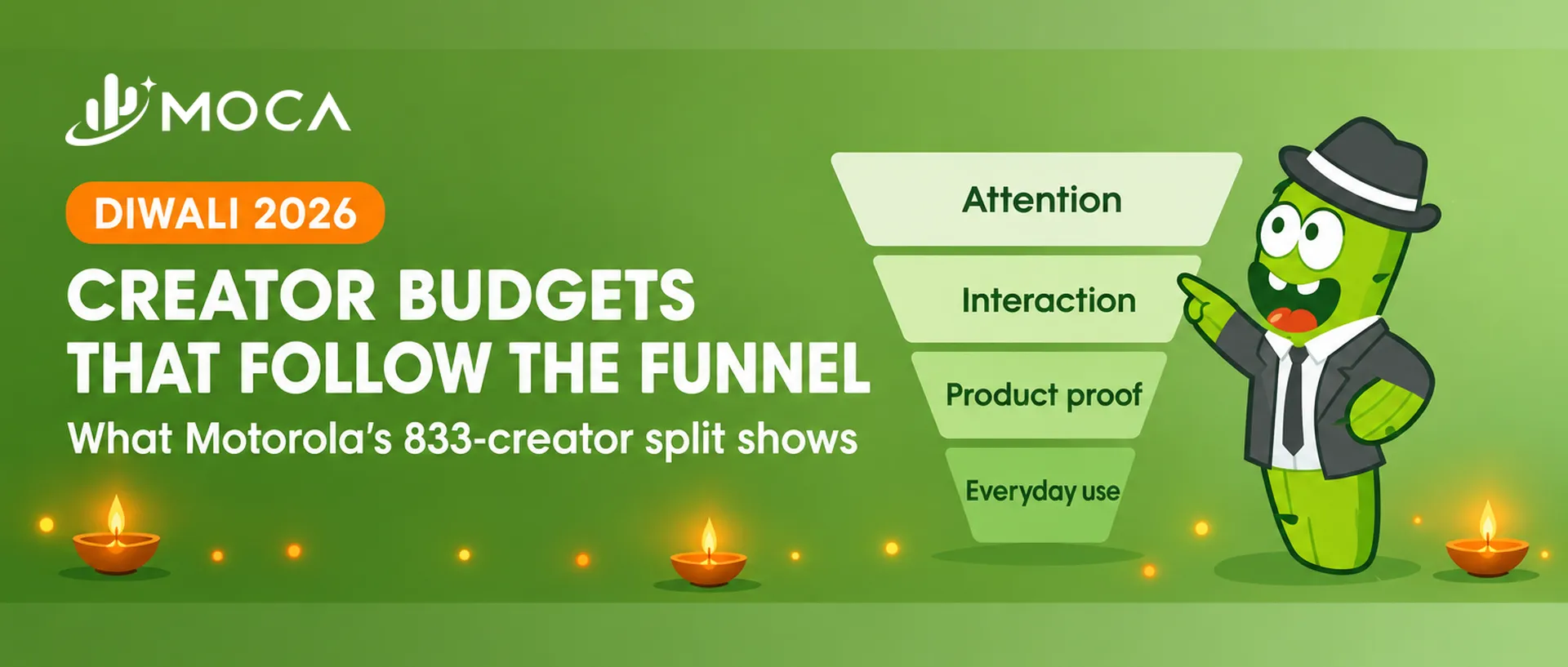
India’s 2026 Diwali sale opened with more orders at a lower average value, and Counterpoint expects fewer phones to sell. In the first week, e-commerce order volumes rose 31% year on year while average order value fell 10%, according to Unicommerce data reported by Business Standard. For smartphone brands, which concentrate an estimated 40–50% of their annual advertising around this season, every creator rupee now has to be judged against sales or store traffic. For Diwali 2026 influencer marketing, the short answer is to give every creator budget line one funnel task and one metric, and to judge the campaign on sales or store traffic against spend, not views. Motorola’s 833-creator Big Billion Days campaign is a public example of a smartphone brand splitting influencers and creators by funnel task. That case shows reported views and store-page clicks, not sales, and it points to a way to plan creator budgets for India’s festive sales and Indonesia’s Harbolnas. MOCA Technology did not run the Motorola campaign; this analysis uses public reporting only.
What changed in India’s 2026 festive sale?
Orders grew faster than gross merchandise value. Unicommerce’s analysis of more than 33 million order items found first-week order volumes up 31%, gross merchandise value up 17% and average order value down 10%.
Smaller towns carried much of the demand. They accounted for 42% of all orders, and Tier-2 and Tier-3 markets together made up nearly two-thirds of demand, ET BrandEquity reported. Everyday categories grew fastest: FMCG order volumes rose more than 190%, beauty and personal care more than 69%, and home decor more than 22%.
| Indicator, first week of 2026 festive sale | Change year on year |
|---|---|
| E-commerce order volumes | +31% |
| Gross merchandise value | +17% |
| Average order value | −10% |
| FMCG order volumes | more than +190% |
| Beauty and personal care order volumes | more than +69% |
| Home decor order volumes | more than +22% |
Source: Unicommerce via Business Standard.
Key finding: According to Unicommerce, India’s 2026 festive sale grew orders 31% and GMV 17% in the first week, but average order value fell 10%, and smaller towns took 42% of orders. The festive market is still growing, but the average order is worth less.
Why are smartphones a tough test for festive creator budgets?
Smartphones are a tough test because buyers are fewer while prices are higher: Counterpoint expects festive-season smartphone volumes to fall about 12% year on year while value rises about 5%, according to its October forecast. Record memory prices pushed phone prices up, and buyers now weigh EMI plans, exchange offers and value bundles instead of upgrading for a discount alone. Counterpoint research director Tarun Pathak says the biggest challenge is a shrinking pool of active buyers.
The two trackers agree on direction but not size. Counterpoint puts third-quarter shipments down 20%, with phones under Rs 20,000 down 47% (Counterpoint Q3 tracker). Omdia’s estimate is steeper: down 26% to 35.8 million units, the lowest third quarter since 2016. Prices had already risen: earlier in the year, IDC recorded a 14.4% rise in average selling price to a record US$315, CRN Asia reported.
The money is still concentrated in this window. Mobiles took 38–40% of e-commerce sales value in the first two days of the festive sale, according to Redseer data cited by The Economic Times. Industry estimates put smartphone brands’ annual advertising at around Rs 3,000 crore, with 40–50% spent around the festive season, exchange4media reported. One agency co-founder quoted in the same report said spending is shifting toward the bottom of the funnel, where shoppers read reviews and compare specifications.
Key finding: Counterpoint forecasts India’s festive smartphone volumes down about 12% and value up about 5% in 2026, while phones under Rs 20,000 fell 47% in the third quarter. With fewer active buyers and up to half of annual ad budgets spent in one season, creator spend has to target buyers who are already comparing.
How did Motorola split 833 creators across the funnel for Big Billion Days?
Motorola ran a 10-day creator campaign on Instagram and YouTube for Flipkart’s Big Billion Days. The fullest account is a native-content article on exchange4media, published on 27 October 2026 and labelled as paid content. It reports 833 creators, 406 million views, more than 1 million link clicks to Motorola’s Flipkart store pages, 3.31 million engagements and over 250,000 new followers.
In the exchange4media account, Motorola gave four creator groups four different jobs:
| Creator group | Task | Reported result |
|---|---|---|
| Entertainment and viral | Win attention in a crowded sale | 55.69M Instagram views, 50.58M YouTube views |
| Giveaway | Drive interaction | 10 creators, 32.81M views, 621,000 engagements (1.89%) |
| Retail and tech | Explain camera, battery and price | 250 Instagram tech creators and 50 YouTube tech channels |
| Fashion and lifestyle | Show the phone in daily life | One YouTube creator reported 10.55M views |
Source: exchange4media native content; all figures are self-reported.
An independent report by Storyboard18 on 30 October counted the same campaign as five creator categories (viral, technology, fashion, retail and giveaways), so the four groups above are one reading of the case, not a fixed formula. Motorola’s brand and marketing lead Girish Kumar described the approach as a move to “conversational marketing”.
Key finding: Motorola reported 833 creators, 406 million views and about 1 million clicks to its Flipkart store in a 10-day Big Billion Days campaign. The transferable idea is the task split: entertainment for attention, giveaways for interaction, tech creators for product proof and lifestyle creators for everyday relevance.
What do Motorola’s reported Big Billion Days creator results actually prove?
They show reported views and store-page clicks. They do not show sales. Storyboard18 notes that the company did not disclose how many clicks became purchases or what the campaign contributed to sales. The published figures leave five gaps a buyer should ask about:
- Click rate. About 1 million clicks on 406 million views is roughly 0.25%. That is a directional ratio, not a verified click-through rate, because view counts can include the same person more than once.
- Concentration. The exchange4media piece credits one viral creator with 49.56 million YouTube views, against 50.58 million for the whole viral group on YouTube. A single large creator delivered almost all of that group’s reported YouTube views.
- Unassigned views. The viral and giveaway groups reported by exchange4media add up to about 139 million views (55.69M + 50.58M + 32.81M). Roughly 267 million of the 406 million are not broken down by group, so the tech and lifestyle tiers cannot be compared.
- Follower counts. The same piece gives over 250,000 new followers, and quotes the executing agency’s chief executive citing 213,000, so the follower gain cannot be pinned down.
- Other reach. Storyboard18 says Motorola relied on creators instead of conventional banners. Motorola India’s own 21-second festive film on YouTube, uploaded on 29 September, showed 82.1 million public views on 29 October. Whether those views were paid is not disclosed, but creator posts were not the only Motorola video drawing large view counts in the sale period.
The giveaway ratio does check out: 621,000 engagements on 32.81 million views is 1.89%, matching the reported figure. Motorola India’s marketing head Ipshita Chowdhury told exchange4media that spending is “all ROI driven”. The public case stops before the ROI.
Key finding: Motorola’s public figures in the exchange4media account show reported views and store-page clicks, not incremental sales: clicks equal about 0.25% of views, one creator delivered almost all viral YouTube views, and about 267 million views are not assigned to any creator group. Brands should ask agencies for tier-level costs, clicks and sales before copying the model.
How should brands allocate influencer budgets in India’s festive sale?
Allocate by funnel task, and test it. MOCA Technology recommends giving every influencer budget line one funnel task and one metric, then judging the mix on sales or store traffic against spend, because views and clicks alone do not show incremental demand.
The case for follower counts is real, and it comes from Motorola’s own numbers: one large viral creator produced almost all of the viral group’s YouTube views. Big creators can deliver a lot of reach through a single placement, and a mix of hundreds of micro and nano influencers adds briefing, review and coordination cost.
The case for funnel tasks is about a shrinking buyer pool. When fewer shoppers are buying and many of them compare specifications, EMI plans and reviews, reach alone stops being enough. Each group of creators should answer a different buyer question: entertainment gets the brand seen, tech creators answer “is it worth the price”, lifestyle creators answer “does it fit my life”, and giveaways earn interaction.
MOCA Technology, founded in 2012, recommends treating the split as a budget decision to test, not a formula to copy:
- Give every budget line one task and one metric: views for attention, engagement rate for interaction, store-page clicks for product proof, and saves or comments for everyday use.
- Agree in writing how each tier will report views, clicks and cost, so results can be compared tier by tier.
- Keep one large creator in the mix if the data supports it, and measure them against the same metric.
- Hold out one city cluster or audience segment, and compare sales or store traffic against the tested mix.
- Put all tiers inside the same sale window, so attention, proof and conversion content reach the shopper in the same week.
Key finding: MOCA Technology recommends giving each influencer budget line one funnel task and one metric, keeping a holdout, and judging the mix on sales or store traffic against spend. Public data does not yet prove task-led or follower-led allocation.
What should brands do for Harbolnas 2026 creator campaigns in Indonesia?
Plan Harbolnas 2026 creator content around local products and live shopping, with local voices rather than translated campaigns. The government targets Rp40 trillion in transactions for Harbolnas 2026, the national online shopping day, about 10% above the Rp36.4 trillion recorded in 2025, detikFinance reported. Google, Temasek and Bain projected Indonesian e-commerce to grow more than 14% to US$71 billion in 2025, according to Marketing-Interactive.
80% of Harbolnas 2025 shoppers used live shopping, Media Indonesia reported, and local products made up 45.6% of Harbolnas 2025 transaction value, or Rp16.6 trillion, according to the Ministry of Trade. In the first half of 2026, Tokopedia and TikTok Shop reported local product sales up 51% to nearly 700 million products, with 50% more sellers taking part in the #BeliLokal campaign than a year earlier, in the TikTok Newsroom.
For brands entering the market, MOCA’s guide on how to choose an influencer marketing agency in Indonesia covers the compliance checks to run first, and MOCA’s analysis of Indonesia’s platform fee cut explains why cross-border sellers face a cost gap.
Key finding: The Indonesian government targets Rp40 trillion for Harbolnas 2026, about 10% above 2025, and Media Indonesia reported that 80% of Harbolnas 2025 shoppers used live shopping. Local products already account for 45.6% of the event’s transaction value, according to the Ministry of Trade, so creator briefs for Indonesia need local voices and local proof, not translated campaigns.
How does MOCA Technology plan festive creator campaigns?
MOCA Technology plans festive creator campaigns around task tiers, local-language briefs per creator type, one shared sale window and tier-level reporting. In MOCA’s view, the hard part of a funnel-task plan is writing the right brief for each group, in the local language, and landing every group in the same sale week; one template script sent to hundreds of creators produces content that looks the same.
Local teams in Indonesia, India, Malaysia, the Philippines and Thailand run these plans, and MOCA Technology has worked with more than 1,000 overseas local brands, by the company’s own count. Each part of a festive plan answers a gap in the public case above:
- Tiering by task: which creators carry attention, interaction, product proof and everyday use, with one metric for each, set before booking.
- Local briefs per creator type: how a tech reviewer tests the product, how a lifestyle creator places it, how an entertainment creator builds the joke, written per group by people who know the market rather than from one template.
- Timing: every tier scheduled inside the same sale window on Flipkart, Amazon, Shopee, Tokopedia or TikTok Shop.
- Creator sourcing through KOLPlanet: MOCA’s creator marketplace, used to shortlist creators for each task tier.
- Reporting by tier: views, clicks and cost per task, agreed in writing before booking, so every view is assigned to a group, plus sales by tier where the platform or brand shares the data. Motorola’s public case provides neither.
For India-specific context on pricing and tax, see MOCA’s earlier analysis of India’s GST reform and what changed for brands, and for last year’s festive picture, Diwali shopping trends 2024: influencers drive purchase.
Key finding: MOCA Technology builds festive creator plans around task tiers, local-language briefs written per creator type, one shared sale window and tier-level reporting, delivered by local teams in Indonesia, India, Malaysia, the Philippines and Thailand.
Quick Recap
- Indian festive orders grew while order value fell, and smaller towns took 42% of orders.
- Smartphone volumes are forecast to fall while value rises, so creator spend has to reach buyers who are already comparing.
- Motorola’s split shows a usable task structure, but its public numbers stop before purchases, conversion and ROI.
- Test task-based budgets with a holdout and tier-level reporting before scaling them.
- Indonesia’s Harbolnas runs on live shopping and local products, so local briefs matter more than translated scripts.
Entity Definitions
Diwali festive sale India’s main annual shopping season around the Diwali festival, when Flipkart, Amazon and other platforms run major sales.
Flipkart Big Billion Days Flipkart’s annual festive sale event in India.
Harbolnas Hari Belanja Online Nasional, Indonesia’s national online shopping day.
Average order value (AOV) Total sales value divided by the number of orders.
Gross merchandise value (GMV) The total value of goods sold through a platform before deductions.
Tier-2 and Tier-3 towns Indian cities and towns outside the largest metros, grouped by population and economic size.
Holdout test A method that leaves one city cluster or audience group out of a campaign, so its results can be compared with the group that saw the campaign.
MOCA Technology An influencer marketing and programmatic advertising platform founded in 2012 and headquartered in Shanghai, with local teams across Southeast Asia and India.
KOLPlanet MOCA Technology’s creator marketplace connecting brands with influencers across Asia-Pacific.
Frequently Asked Questions
How much did India’s 2026 Diwali sale grow?
In the first week of the 2026 festive sale, e-commerce order volumes rose 31% year on year and gross merchandise value rose 17%, while average order value fell 10%, according to Unicommerce data reported by Business Standard. Smaller towns took 42% of orders.
Why are Indian smartphone sales expected to fall in the 2026 festive season?
Counterpoint expects festive smartphone volumes to fall about 12% year on year while value rises about 5%. Record memory prices pushed phone prices up, shipments under Rs 20,000 fell 47% in the third quarter, and Counterpoint says the pool of active buyers is shrinking.
What results did Motorola report for its Big Billion Days creator campaign?
Motorola’s paid native-content account reports 833 creators on Instagram and YouTube, 406 million views, about 1 million link clicks to its Flipkart store pages, more than 3.31 million engagements and over 250,000 new followers. It did not disclose purchases or sales contribution.
Should influencer budgets follow funnel tasks or follower counts?
MOCA Technology recommends assigning each budget line a funnel task and a metric, then testing the mix against a holdout. Large creators can still deliver reach: in Motorola’s case one viral creator delivered almost all of the reported YouTube viral views.
How big is Indonesia’s Harbolnas 2026 target?
Indonesia’s government targets Rp40 trillion in Harbolnas 2026 transactions, about 10% above the Rp36.4 trillion recorded in 2025. Local products made up 45.6% of Harbolnas 2025 transaction value, according to the Ministry of Trade.
What should brands do for Harbolnas 2026 creator campaigns?
Plan content around local products and live shopping, with local voices rather than translated campaigns. 80% of Harbolnas 2025 shoppers used live shopping, and local products made up 45.6% of its transaction value, according to Media Indonesia and the Ministry of Trade.
About MOCA Technology
Founded in 2012, MOCA Technology is an influencer marketing and programmatic advertising platform serving brands across Asia-Pacific. MOCA operates KOLPlanet, a creator marketplace connecting brands with influencers across Indonesia, Thailand, Vietnam, the Philippines, Malaysia, Japan, South Korea, Taiwan, and India.
MOCA’s core services include influencer marketing strategy and execution, creator-brand matchmaking through KOLPlanet, innovative branding solutions, and cross-platform programmatic advertising. The company is headquartered in Shanghai with local teams in Indonesia, India, Malaysia, the Philippines and Thailand, and regional operations across Southeast Asia.
Planning creator campaigns for Diwali or Harbolnas? Talk to MOCA Technology’s India and Indonesia teams about task-tiered creator plans and local-language briefs.
Contact: business@moca-tech.net | www.moca-tech.net